
Tata Group on Wednesday announced an investment of 4 billion pounds (about Rs 42,500 crore) in setting up a flagship factory to make batteries for Jaguar Land Rover as well as other manufacturers. Tata Sons, owner of JLR, chose Bridgwater in Somerset in southwest England for the gigafactory over a rival location in Spain. The gigafactory, at 40GWh, will be one of the largest in Europe and Tata's first outside of India, the conglomerate said in a statement.

While the tax holiday for the factory coming to an end might be a factor, many say the business model of Microsoft (which acquired Nokia's handset division last year), as well as freebies offered by the Vietnamese government, might also have played a role.
A reading above 50 means the sector is expanding, while a reading below 50 means contraction.

The limited availability of flexible (flex)-fuel vehicles in the Indian market and the slow rollout of ethanol-blended petrol by oil-marketing companies (OMCs) remain major obstacles to achieving widespread use of biofuels in the transportation sector in India. Recently, two Union ministers have emphasised India's biofuel potential, arguing that it has the capacity and potential to lead a transition towards widespread biofuel adoption. Road Transport Minister Nitin Gadkari signalled that this transition is well underway and urged car manufacturers to quickly adapt and introduce new biofuel-run vehicles, lest the government resort to taxing diesel vehicles.

The Department of Telecom is believed to have sought a 15-year tax holiday on domestic production of handsets and a lower unifom VAT rate among other relaxations to rejuvenate mobile phone manufacturing in the country.

GVA growth in the manufacturing, farm and construction sectors tumbled.

'The pipeline of new industrial projects is the best I've seen in the last 10 years, and it looks solid enough to sustain for at least a few quarters,' points out Naushad Forbes, adding, 'It is only when we get back to the same labour force participation we saw before Covid that the economy will have truly recovered.'

Serum Institute of India CEO Aadar Poonawalla has said that the production of Covid-19 vaccine Covishield is in full swing in Pune and he will review the operations once he is back in the country in a few days. Poonawalla is currently in the UK to meet his family members.

Top losers in the Sensex pack included ICICI Bank, Tata Steel, Vedanta, HDFC IndusInd Bank, Tata Motors, RIL and ONGC -- falling up to 4.45 per cent.

Consumer goods firms and auto companies are witnessing an upturn in rural demand, which had been lagging for most of FY24. Expectations of a bumper rabi crop harvest have helped turn the tide. The Reserve Bank of India's (RBI's) Monetary Policy Committee kept the repo rate unchanged last week, noting that as rural demand catches up, consumption is expected to support economic growth in 2024-25.

The manufacturing sector now contributes about 16-17 per cent to the GDP

'When you do some job for a few hours, you are hardly earning enough to survive.'

India's industrial production growth slowed down for a fourth straight month in December to 0.4 per cent mainly due to a poor performance by the manufacturing sector. The manufacturing sector, which constitutes 77.63 per cent of the Index of Industrial Production (IIP), contracted by 0.1 per cent in December, according to the data released by the National Statistical Office (NSO) on Friday. In December 2021, the mining output rose by 2.6 per cent, and power generation increased by 2.8 per cent.

Macroeconomic data announcements, global trends and trading activity of foreign investors would guide momentum in the equity market this week, analysts said. Markets ended a five-week losing streak and gained nearly a per cent last week, helped by a sharp rebound on Friday. Last week, the BSE benchmark jumped 500.65 points or 0.77 per cent and the Nifty gained 169.5 points or 0.87 per cent.
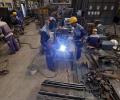
Industrial production growth entered positive territory after a gap of two months with a record 22.4 per cent rise in March this year, mainly due to the low-base effect and good show by manufacturing, mining and power sectors. The manufacturing sector -- which constitutes 77.63 per cent of the index of industrial production (IIP) -- grew by 25.8 per cent in March 2021, as per the data released by the National Statistical Office (NSO) on Wednesday. The mining sector output too grew 6.1 per cent in March, while power generation increased by 22.5 per cent.

Services sector activities in India picked up marginally in February on the back of better demand conditions and the retreat of the coronavirus pandemic but the rate of expansion was the second-slowest since last July and subdued by historical standards, according to a monthly survey. Reflecting a moderate rate of expansion, the seasonally adjusted IHS Markit India Services Business Activity Index rose to 51.8 in February from 51.5 in January. "The upturn was attributed by panellists to greater bookings, better demand conditions and the retreat of the pandemic. "That said, the latest increase was subdued by historical standards, with some companies indicating that growth was dampened by competitive pressures, COVID-19 and higher prices," the survey released on Friday said.

The critical information in the first quarter (Q1) gross domestic product (GDP) data relates to the proximity of real and nominal GDP growth rates at 7.8 per cent and 8 per cent, respectively. The implicit price deflator (IPD)-based inflation is only 0.2 per cent. This phenomenon has repeated after fifteen quarters.

Low-cost carrier IndiGo has asked American aerospace manufacturer Pratt & Whitney (PW) to quickly provide engines for the airline to press its grounded planes back into service, sources said on Wednesday. The airline wants to increase its domestic frequency to fill the supply-side void created after Go First's exit, they added. Go First stopped operating flights from May 3 after filing an insolvency application with the National Company Law Tribunal.

The report also said that in past DEG outbreaks, manufacturers have been suspected of substituting DEG in the place of more expensive, pharmaceutical-grade solvents.

From the Sensex pack, State Bank of India, Axis Bank, IndusInd Bank, Tech Mahindra, HCL Technologies, Tata Consultancy Services, Maruti Suzuki, Tata Steel and Tata Motors were the major gainers. Power Grid and HDFC Bank were the laggards from the pack.
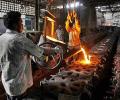
India's manufacturing sector activity was largely flat in April, as rates of growth for new orders and output eased to eight-month lows amid the intensification of the COVID-19 crisis, a monthly survey said on Monday. The seasonally adjusted IHS Markit India Manufacturing Purchasing Managers' Index (PMI) was at 55.5 in April, little changed from March's reading of 55.4. In PMI parlance, a print above 50 means expansion while a score below 50 denotes contraction.
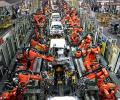
India's economy grew 6.1 per cent in the fourth quarter of 2022-23, pushing up the annual growth rate to 7.2 per cent, official data showed on Wednesday.

India's economy is likely to grow by 12 per cent in 2021 following a 7.1 per cent contraction last year, as near-term prospects have turned more favourable, Moody's Analytics said. A stronger than expected December quarter GDP growth of 0.4 per cent following a 7.5 per cent contraction in the previous three months has turned India's near-term prospects more favourable, it said. Domestic and external demand has been on the mend since the easing of restrictions, which has led to improved manufacturing output in recent months.

City sales stood at 4,600 units in September.

Major IT firms such as Tata Consultancy Services, HCL Technologies, Infosys, Cyient, and L&T Technology Services have direct exposure to Boeing or its suppliers' ecosystem, which comprises engine manufacturers, body suppliers, and avionics providers. These firms provide services like application development, testing, engineering, avionics, and business process management for the Boeing 737 Max programme.

Mining output climbed 23.3 per cent and power generation increased 7.5 per cent in May. The IIP had contracted 33.4 per cent in May 2020. Industrial production has been hit due to the coronavirus pandemic since March last year when it had contracted 18.7 per cent. It shrank 57.3 per cent in April 2020 due to decline in economic activities in the wake of the lockdown to curb the spread of coronavirus infections. The IIP had registered a growth of 5.2 per cent in February last year.

Industrial production contracted by 1.9 per cent in November, entering the negative territory after a two-month gap, mainly due to poor showing by manufacturing and mining sectors, official data showed on Tuesday. The manufacturing sector -- which constitutes 77.63 per cent of the index of industrial production (IIP) -- recorded a contraction of 1.7 per cent in November 2020, as per data released by the National Statistical Office (NSO). Mining sector output too witnessed a decline, shrinking 7.3 per cent.

Industrial production declined by 8 per cent in August, mainly due to lower output of manufacturing, mining and power generation sectors, official data showed on Monday. According to the Index of Industrial Production (IIP) data, manufacturing sector production registered a decline of 8.6 per cent, while the output of mining and power segments fell 9.8 per cent and 1.8 per cent, respectively.

The Indian economy is estimated to grow at 7 per cent in the 2022-23 fiscal, down from 8.7 per cent a year ago, mainly due poor performance of mining and manufacturing sectors. As per the first advance estimates of national income released by the National Statistical Office (NSO) on Friday, the manufacturing sector output is estimated to decelerate to 1.6 per cent in the current fiscal from 9.9 per cent in 2021-22. Similarly, mining sector growth is estimated at 2.4 per cent in the current fiscal as against 11.5 per cent in 2021-22.

The finance minister admitted that there was no quick-fixes to economic problems and the government is working to stabilise the economy which may take time.

Industrial output grew by 7.1 per cent in April on better performance by power and mining sectors, as per government data released on Friday. Manufacturing sector recorded a growth of 6.3 per cent in the first month of the current financial year, as per the data released by the National Statistical Office (NSO). It further said growth rates over corresponding period of the previous year are to be interpreted considering the unusual circumstances on account of the COVID-19 pandemic since March 2020.

A careful reading of the national income accounts suggests that after a strong recovery from the pandemic, there has been a significant ebbing of dynamism over the last three quarters to more modest levels recently, note Arvind Subramanian and Josh Felman.

A few days back, Atul Ganatra, president of the Cotton Association of India, presented a grim scenario of the crop's prospects in the 2024-25 season that starts in October. Addressing the association's annual general meeting, Ganatra said the area under the crop could go down by at least 10 per cent in the coming season due to falling yields and realisation, leading to farmers losing interest. The fear of a decline in acreage comes against the backdrop of India's cotton production probably falling to its lowest in a decade, according to estimates.

Chinese shares opened lower, with the Shanghai Composite Index down 1.8% and the CSI300 index down 2.2%.

'India's future: To manufacture so efficiently that we do not need protection,' says Naushad Forbes.

The share of foreign companies in private sector investments, directed towards building new factories and other facilities, has declined over the past six months. A mix of large domestic announcements and relatively lower growth in foreign capital expenditure (capex) plans have played a role, although foreign investments remain near record levels. The share of foreign companies in the overall private sector investments over the four quarters ended June 2023 has dipped to 14.9 per cent, as shown by a Business Standard analysis of data from the project tracker Centre for Monitoring Indian Economy.

India appears poised to sustain its growth in a more durable way than before with the economy carrying the momentum from FY23 into the current fiscal year, the Annual Economic Review for 2022-23 released by the finance ministry on Thursday said. However, the report cautioned that escalation of geopolitical stress, enhanced volatility in global financial systems, sharp price correction in global stock markets, a high magnitude of El-Nino impact, and modest trade activity and FDI inflows, are factors that could constrain the pace of growth. "Should these developments deepen and dampen growth in the subsequent quarters, the external sector may challenge India's growth outlook for FY24," the finance ministry said.

The Industrial of Index Production was 1.9 per cent in April and 2.5 per cent in May last year, as per the data released by Central Statistical Organisation.

Benchmark indices Sensex and Nifty settled with gains for the third straight session on Monday, helped by buying in auto, banking and capital goods shares despite a spike in crude oil prices. The 30-share BSE Sensex rose 114.92 points or 0.19 per cent to close at 59,106.44 points with 22 of its components ending in the green and eight closing lower. It moved in a range of 58,793.08 points to 59,204.82 points during intra-day trade.

Even as India strives to climb the development mountain, the fact is that the mountaintop is already crowded. If it got there in 2047, India would be very much a late-comer, observes T N Ninan.
